


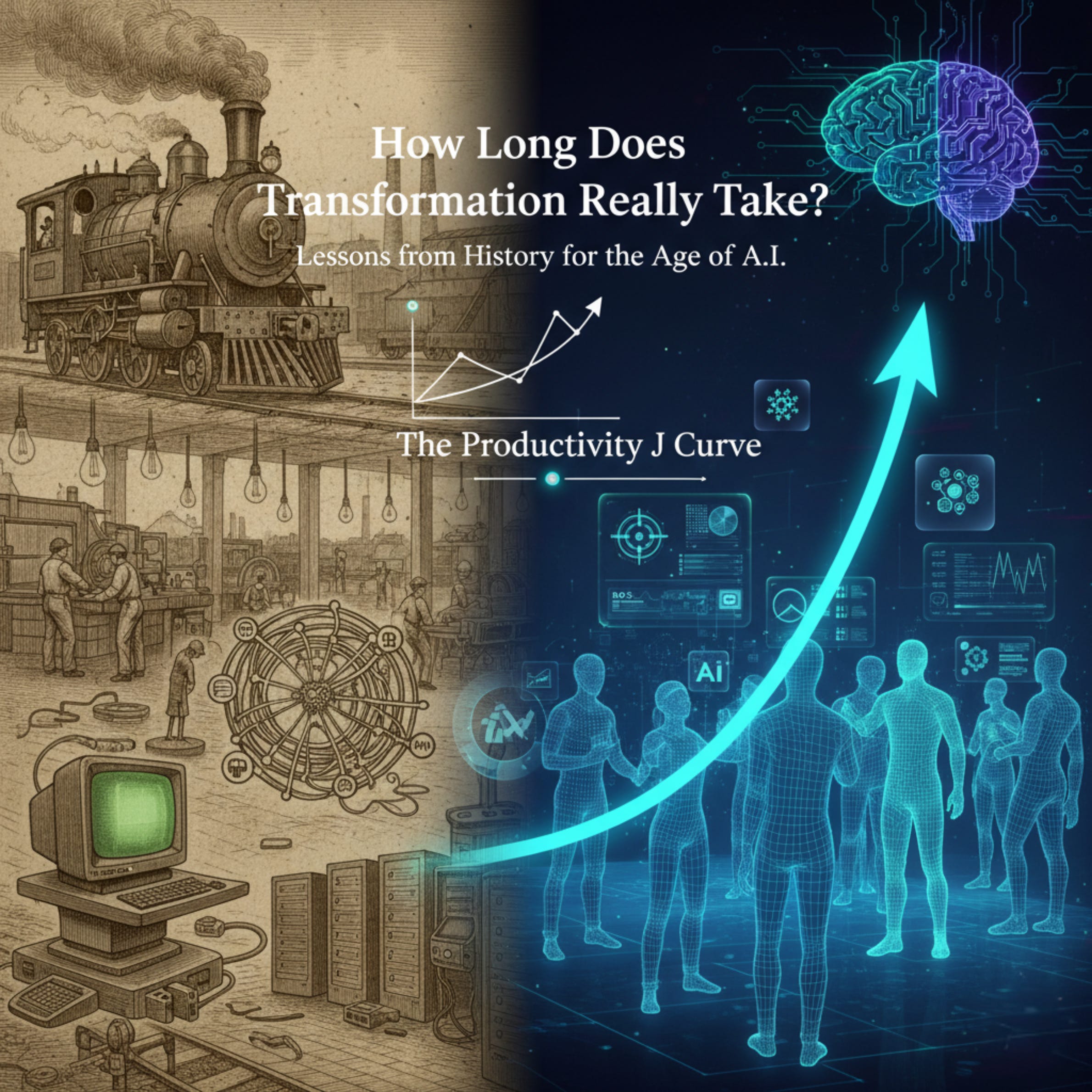
We often talk about transformation as if it is a single moment. In reality, transformation unfolds as a curve. If we look at history, it begins with a period of investment and disruption before any real impact appears. Economists refer to this as the Productivity J Curve. Performance drops at first, then rises sharply once people and systems adapt.
Today, as organizations rush to adopt A.I., it helps to remember that every major shift before this one followed the same pattern.
Looking Back at the Long Arc of Change
Steam engines changed the world, but not instantly. The same was true for electricity, computers, and the internet. The delay was rarely due to the technology itself. The real barrier was how long it took for people and organizations to redesign work around it.
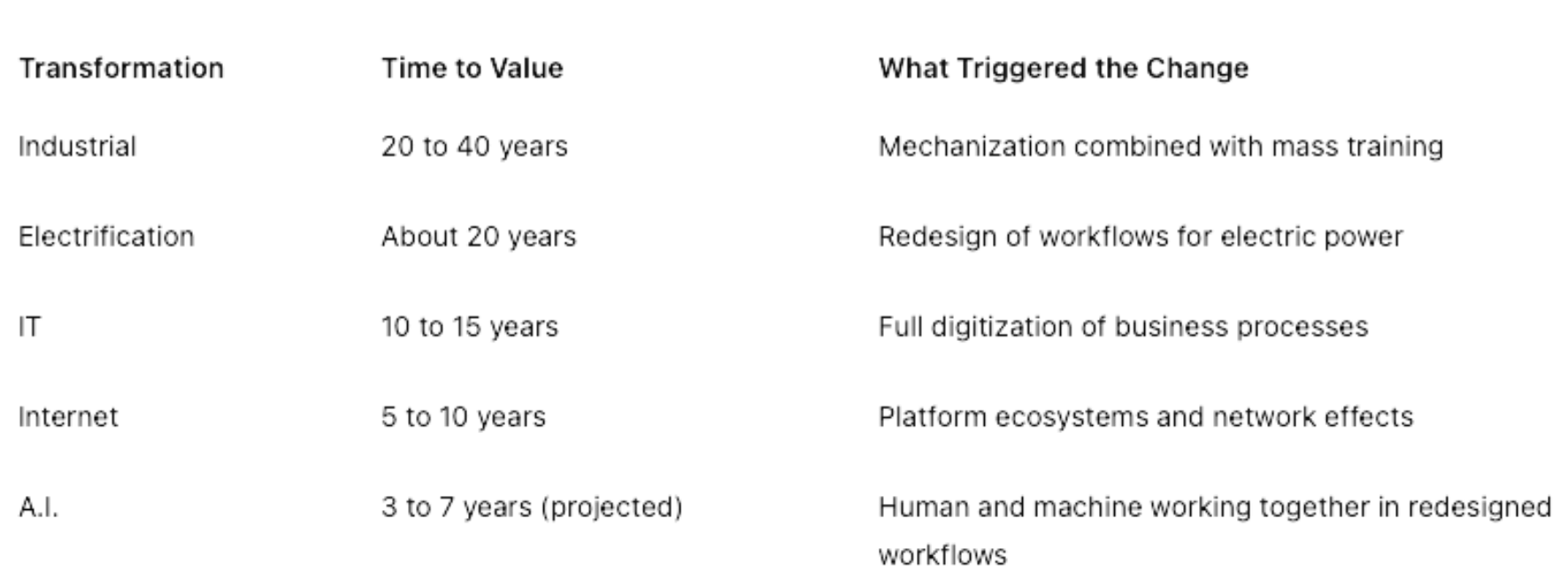
The Industrial Revolution took between twenty and forty years before productivity gains were visible.
Electrification took roughly twenty years because factories initially swapped steam for electricity without changing workflows.
The IT Revolution took about ten to fifteen years as organizations digitized processes.
The Internet Age compressed the cycle to five to ten years as connectivity and digital literacy increased.
The pattern is consistent. Technology moves fast. Organizations move slowly.
Understanding the Productivity J Curve
The J Curve shows that early investment creates a temporary decline in performance. Training, experimentation, workflow redesign, and mindset shifts all take time. Only when these elements align does value begin to rise.
Erik Brynjolfsson at MIT attributes this to the need for “organizational rewiring.” He argues that while technology races ahead, the “intangible assets” including new skills, processes, and culture take much longer to build. That gap explains why early results often feel disappointing.
Where A.I. Is on the Curve Today
Right now, most companies are in the learning phase of A.I. transformation. Tools are everywhere. Copilots. Analytics assistants. Workflow generators. Yet only around thirty percent of organizations report measurable value.
This mirrors the early phase of digital transformation in the 2000s. Excitement was high, practices were immature, and results varied.
However, there is one important difference. We are working on top of decades of digital infrastructure. Cloud adoption, API integration, data pipelines, and digital skills were built long before generative A.I. arrived. These layers shorten the adoption timeline significantly.
As a result, what once took twenty years for electricity or ten years for the internet could take between three and seven years for A.I. if we approach the human side of transformation with intention.
People Are the Accelerator
A.I. will not change work simply because tasks can be automated. It will change work when organizations redesign how decisions are made and how people collaborate with these new systems.
Trust, experimentation, and skill development matter more than model selection or platform choice. The pace at which people adapt will determine how fast organizations climb the curve.
Lessons from Earlier Transformations
The Takeaway
Transformation has never been instant. It is a process of continuous learning, unlearning, and redesign. If your organization is not seeing immediate A.I. results, it does not mean you are behind. It means you are in the part of the curve where the real work happens.
The organizations that treat this period as a time to strengthen capability, experiment with intention, and redesign work thoughtfully will be the ones that benefit most when the curve begins to rise.
A Question to Reflect On
How long do you believe it will take for A.I. to create visible impact in your world of work? Are we still experimenting or starting to transform?